
Content
Blogs

The Power Paradox
The global consumer electronics market size was calculated at USD 870 billion in 2025 and is predicted to increase to approximately USD 943.08 billion in 2026. The growing demand for consumer electronics, and GPUs is becoming resources for the fittest (Source: Precedence Research) North America is expected to grow at the fastest rate during the forecast period. Smart home devices and connected health technologies are expanding as convenience, security, and wellness become core value drivers.
“We will see more of our OEM and ODM partners quickly scale these AI capabilities to multiple price points with the identical user experience because we use the same NPU (neural processing unit) core across all of these tiers,” Alex Katouzian, Group General Manager of Mobile, Compute and XR at Qualcomm Technologies, Inc.
The Demand Imperative
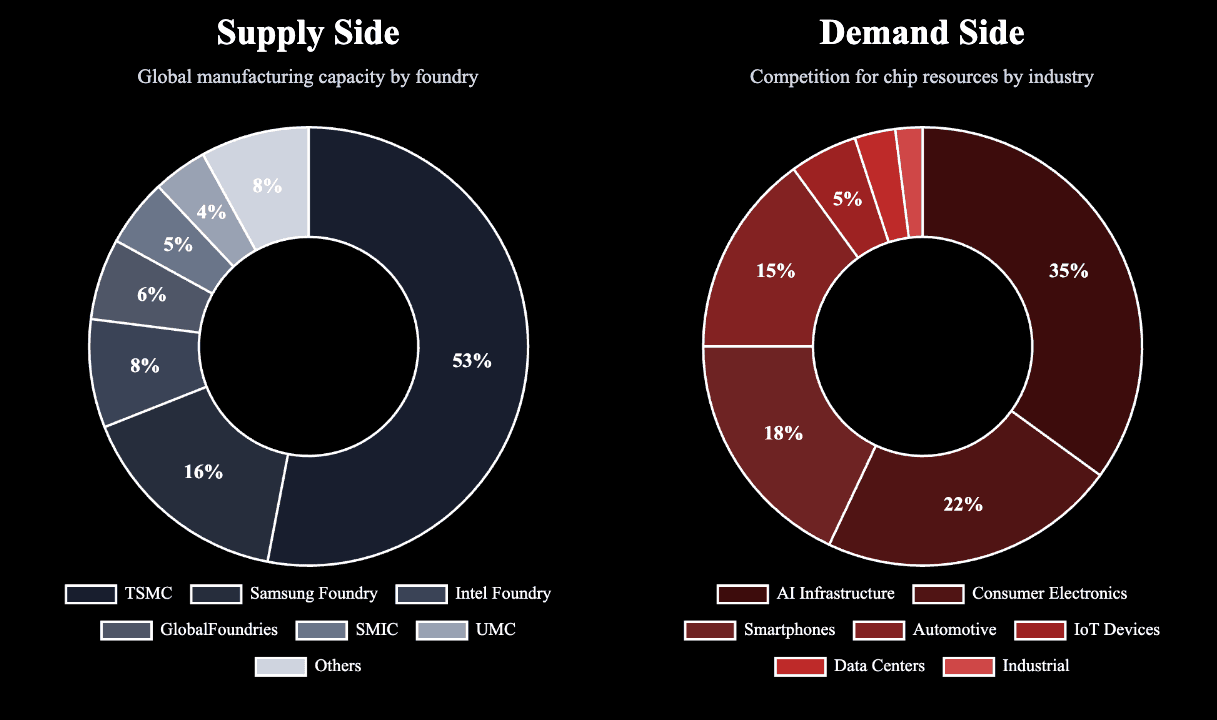
Here's the catch; almost all companies are now competing for the same chip suppliers or raw material procurements and one can't win on order size alone. There are 2x main value chains involved:
Raw Material Procurement: The stage acquires raw materials like conductive metals, plastics, chemicals, semiconductors, batteries, ceramics, chips, and glass (key players- Samsung Semiconductors, Micron)
Manufacturing and Assembly: The manufacturing and assembly involve steps like PCB fabrication, sourcing of components, assembling the final product, testing, quality control, and packaging (key players- Foxconn, Jabil)
The cost structure of a smartphone is heavily dependent on the memory used. For a mid-range device, memory can represent 15-20% of the total bill of materials (BOM), while for a high-end flagship device, it is around 10-15%. As memory prices continue to surge, OEMs will likely have to raise prices significantly, cut specifications or both
Source: DiMarket Semiconductor Foundry Market Analysis 2026
The Opportunity: Data Integration to Learn User Behavior
To remain competitive in this sector, data integration has become pervasive, evolving from an optional feature into a core operating system that allows devices to learn user behaviors and anticipate needs. Beyond simple voice commands, this "anticipatory intelligence" is hyper-personalized experiences in everything from smart home hubs to wearables that proactively monitor health (Source: Precedence Research)
Manufacturers that embed data capabilities into their devices create business impact in the 3 key areas:
Faster cycles, simpler SKUs. Data enabled personalization means consumer electronic enterprises can serve diverse customer needs with fewer physical product variants. Instead of launching five different SKUs (each requiring separate components), you ship one adaptable platform. This reduces procurement complexity and makes you a more predictable, lower-risk customer to supply. OEMs already leverage their predictive insights to ramp production, LLMs can collect data to help companies drive personalization at scale- something that would otherwise require multiple NPIs
Data that suppliers want. Consumer electronics sit in people's homes, cars, and pockets collecting usage patterns and performance insights. B2Bs that share anonymized analytics back to chip makers help them improve future designs. This transforms the relationship from transactional to strategic partnership
Higher value per component: data-enabled devices command improved data around utilization & so command higher margins- justifying the premium component allocation. When suppliers choose between a simple product and one that processes real-time data they pick the latter- it deepens value prop for everyone in the chain
The Path Forward: Strategic Partnership Over Purchase Orders
Transform from commodity buyer to strategic partner. Share real-world usage data with OEMs/ODMs & chip suppliers to help them improve future designs, consolidate product variants through model-adaptive platforms & reduce procurement complexity. Co-invest in next-generation component development. Companies that make suppliers smarter earn allocation priority when shortages hit while competitors stuck in transactional relationships get rationed. Start with one supplier, one data-sharing pilot, and scale what works.